CityPlace, Toronto — Fort York & the Harbourfront Updated for the August 2026 marketFirst-Time Buyer GuideIs your CityPlace landlord getting rich off your rent?A first-time home buyer's

Dated: September 6 2026
Views: 6
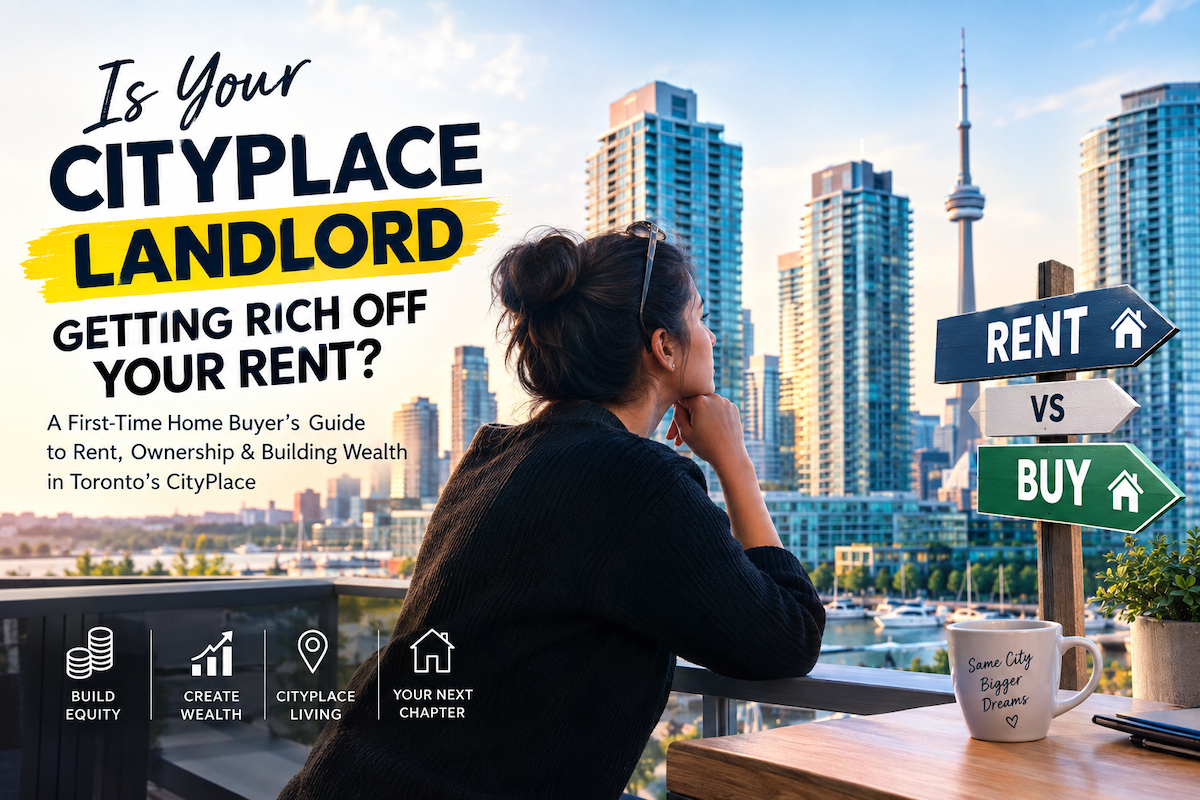 Toronto skyline from a balcony, with a signpost pointing to Rent and Buy" style="width: 100%; height: auto; display: block; margin: 0 0 0;" />
First-Time Buyer Guide
A first-time home buyer's guide to rent, ownership and building wealth in Toronto's CityPlace.
You open your banking app.
Rent: $2,400.
Next month? $2,400.
The month after that? $2,400.
And before you know it, you've transferred tens of thousands of dollars to your landlord without owning a single square foot of the condo you live in.
Is your CityPlace landlord getting rich from your rent — or are you simply paying for the privilege of living in someone else's asset?
The answer isn't as simple as "rent is throwing money away."
Buying a home comes with a mortgage, property taxes, condo fees, insurance, maintenance, closing costs and interest. In some situations, renting can absolutely be the smarter financial decision.
But for a renter who plans to stay in Toronto for several years, has stable income, has saved for a down payment and wants to build long-term wealth, there is another question worth asking: what would happen if some of the money you're currently paying toward housing went toward an asset you owned?
That's where the rent-versus-buy conversation gets interesting — and if you're living in CityPlace, the numbers may be worth a closer look.
CityPlace has become one of downtown Toronto's most recognizable condo communities. Close to the Financial District, Union Station, the waterfront, Rogers Centre, Scotiabank Arena and major transit connections, the neighbourhood attracts a large population of renters and young professionals.
That makes it a good place for a first-time buyer to study. You can rent a condo here, or you can potentially purchase a similar one. The question isn't simply "can I afford the mortgage?" — it's what does my entire financial picture look like if I rent versus own?
Rental prices vary considerably depending on the building, unit size, view, parking, locker, renovations and amenities. In August 2026, tracked CityPlace/Fort York lease transactions averaged approximately $2,822 per month, while one-bedroom units averaged approximately $2,328 and two-bedroom units approximately $3,224. Another rental-market source places the broader CityPlace median rent around $2,300 per month for the same period.
Let's use a simple example: a CityPlace condo renting for $2,400 a month.
That's a substantial amount of money. Of course, you received something valuable in exchange: a place to live. So it's inaccurate to say every dollar of rent is "lost." But there's a major difference between paying for housing and building equity. When you rent, you generally don't acquire ownership in the property. When you own, part of your mortgage payment can go toward reducing the principal balance — a distinction every first-time buyer should understand.
Absolutely, and this is where the conversation gets more interesting. Your landlord isn't necessarily depositing your entire rent cheque into a bank account and celebrating every month. A property owner may face mortgage payments, property taxes, condo fees, insurance, repairs, vacancy periods, property management, leasing and legal costs, special assessments and financing costs.
So if you're paying $2,400 in rent, the landlord may not be making $2,400 in profit — the property could even have negative monthly cash flow. So why own it? Because real estate wealth can come from several different sources.
If rent is higher than the property's operating expenses and financing costs, the owner may generate positive cash flow.
But remember: actual calculations are much more complicated.
This is the part renters often overlook. Every mortgage payment generally consists of interest and principal — interest is the cost of borrowing, principal reduces the amount owed. While the landlord is making a monthly payment, part of it may be reducing their debt and increasing their equity. A renter doesn't receive that benefit from their rent payment.
If a property increases in value over time, the owner's equity can potentially increase — a condo purchased for $600,000 that later becomes worth $700,000 is a $100,000 increase in value. But appreciation is not guaranteed, and Toronto real estate can go down as well as up.
That's a useful reminder: buying real estate is not a guaranteed short-term investment.
One of the most powerful — and misunderstood — concepts in real estate. Imagine you purchase a $600,000 condo with a $120,000 down payment. You're controlling a $600,000 asset with $120,000 of your own capital, subject to mortgage qualification and financing costs.
This simplified example ignores mortgage interest, land transfer tax, legal fees, realtor fees on sale, maintenance, condo fees, property taxes and market fluctuations. That's why leverage can amplify both gains and losses.
Maybe. Maybe not. The more important question is: are you building wealth from the money you're spending on housing? Two people can spend almost the same amount on housing and end up in very different financial positions.
Pays rent → receives housing → generally doesn't build property equity.
Pays housing costs → receives housing → may build equity through principal repayment and potentially appreciation, alongside greater responsibility and risk.
That's why the decision should never be "renting is bad, buying is good." It should be: which option makes sense for my financial situation and my timeline?
A mortgage isn't the entire cost of owning. On top of the mortgage payment, you also need to consider condo fees, property taxes, insurance, maintenance, closing costs, potential interest-rate changes, mortgage renewal and special assessments — plus transaction costs when you sell. The real comparison is the total cost of renting versus the total cost of owning, not rent versus mortgage.
Recent Toronto housing analysis similarly highlights that comparing rent only with the mortgage payment can produce a misleading picture, since ownership also involves property tax and condo fees while mortgage principal can contribute to equity.
Because ownership can provide something renting generally doesn't: equity. Over time, the mortgage balance decreases while the property value potentially increases, which can add up to increasing equity.
If the property later becomes worth $650,000 and the mortgage balance falls to $450,000, equity grows to $200,000. Again, this is a simplified illustration, not a prediction — the market could move in the opposite direction. But it's the fundamental wealth-building mechanism many homeowners are pursuing.
If you're planning to move in 12 months, buying may not make sense. If you expect to stay 5–10 years, the conversation changes.
Homeownership creates long-term financial obligations, so you need to be comfortable with your income and employment situation.
Don't think only about the down payment — budget for closing costs and an emergency fund too.
Mortgage, property taxes, condo fees, insurance, utilities, maintenance and emergency expenses, all together.
Condo ownership comes with shared building responsibilities — low-maintenance doesn't mean zero maintenance.
If you're a first-time home buyer in Ontario, you may qualify for certain programs and rebates. Eligibility matters, and buyers should confirm current rules with their lawyer or the relevant government authorities.
Today's Toronto condo market isn't the ultra-competitive market many buyers remember from previous years. TRREB's Q2 2026 condo report showed sales activity improving even as prices softened:
For a buyer, that combination can create something valuable: choice. Instead of rushing into the first condo you see, you can compare buildings, locations, prices, maintenance fees, parking, lockers, views, building history, rental potential and recent comparable sales — a very different environment from a market where buyers feel forced into immediate decisions.
Renting can be an excellent choice — while you're building your down payment, paying off debt, growing your career, unsure where you want to live, saving for a larger property, uncomfortable with market risk, or unable to qualify for a mortgage yet. In those situations, renting provides flexibility.
Current rental conditions may even give tenants some breathing room: TRREB reported that GTA condo rental transactions increased 4.2% year-over-year in Q2 2026, while average condo rents remained below year-ago levels — the average one-bedroom condo rent was approximately $2,273 and the average two-bedroom was approximately $3,013.
So renters shouldn't feel pressured into buying simply because someone tells them they're "throwing their money away." That's bad financial advice.
If you're renting today, don't just ask "when can I buy?" Ask: what needs to happen for buying to become financially comfortable?
Don't buy because you're frustrated about rent. Don't buy because your friend bought. Buy because the numbers and your life make sense.
Homeownership is a financial decision and a lifestyle decision.
The goal isn't simply to become a homeowner. The goal is to become a financially prepared one.
Your rent isn't automatically bad. Your landlord isn't automatically getting rich. And buying isn't automatically better. The real problem is making a major financial decision without understanding the numbers.
Five years from now, you could still be paying rent. Or you could be building equity. Neither outcome is guaranteed — but the decision deserves to be intentional.
Start with the numbers, not the pressure. Take your current rent, savings, income, debts and desired neighbourhood, and compare them against realistic CityPlace condo options. And if buying isn't right for you yet — that's useful information too.
Real estate markets, rents, interest rates, condo fees and individual property costs change constantly. The examples in this article are illustrations and should not be treated as financial or mortgage advice. For a real rent-vs-buy decision, use current property-specific numbers and speak with qualified mortgage, legal and financial professionals where appropriate.

Samta Makkar is a Downtown Toronto realtor with Royal Canadian Realty, Brokerage, specializing in first-time buyers and move-up sellers across King West, Liberty Village, St. Lawrence Market, CityPlac....
CityPlace, Toronto — Fort York & the Harbourfront Updated for the August 2026 marketFirst-Time Buyer GuideIs your CityPlace landlord getting rich off your rent?A first-time home buyer's
Downtown Toronto Real Estate Desk·Half-Yearly Report H1 2026First-Time Buyer Guide · Financial DistrictThe Financial District market, read like a ledger.A half-yearly look at pricing,

The listing data displayed is deemed reliable but is not guaranteed accurate by CREA®. Data last updated on September 23, 2026 6:40 PM UTC The trademarks REALTOR®, REALTORS®; and the REALTOR® logo are controlled by The Canadian Real Estate Association (CREA®) and identify real estate professionals who are members of CREA®. Used under license. The trademarks MLS®, Multiple Listing Service® and the associated logos are owned by The Canadian Real Estate Association (CREA®) and identify the quality of services provided by real estate professionals who are members of CREA®. Used under license.
Show More...
 Data provided by the Ontario Regional Technology & Information Systems. The information is deemed reliable, but is not guaranteed. Not intended to solicit buyers or sellers, landlords or tenants currently under contract.
The trademarks REALTOR®, REALTORS® and the REALTOR® logo are controlled by The Canadian Real Estate Association (CREA) and identify real estate professionals who are members of CREA. The trademarks MLS®, Multiple Listing Service® and the associated logos are owned
by CREA and identify the quality of services provided by real estate professionals who are members of CREA. Used under license.
REALTOR® contact information provided to facilitate inquiries from consumers interested in Real Estate services. Please do not contact the website owner with unsolicited commercial offers.
Show More...
Data provided by the Ontario Regional Technology & Information Systems. The information is deemed reliable, but is not guaranteed. Not intended to solicit buyers or sellers, landlords or tenants currently under contract.
The trademarks REALTOR®, REALTORS® and the REALTOR® logo are controlled by The Canadian Real Estate Association (CREA) and identify real estate professionals who are members of CREA. The trademarks MLS®, Multiple Listing Service® and the associated logos are owned
by CREA and identify the quality of services provided by real estate professionals who are members of CREA. Used under license.
REALTOR® contact information provided to facilitate inquiries from consumers interested in Real Estate services. Please do not contact the website owner with unsolicited commercial offers.
Show More...
